

Can you imagine steering a traditional coach with a communication based steering system? In fact you do as a coachman. Let’s dive into that.
The Coach Steering System
The Coach Steering
Usually coaches have two fixed axles, the front axle connected with the kingpin to the coach.
By turning the front axle clockwise, the coach drives to the right when it is in forward motion. By turning it counter clockwise the coach drives to the left.
The energy needed to turn the axle (also the propulsion energy) and the command is transmitted by the drawbar.
The Power Supply
The Power supply for the coach is provided by at least one horse. The horse power is responsible for traction power and for steering power of the coach.
The Human Machine Interface
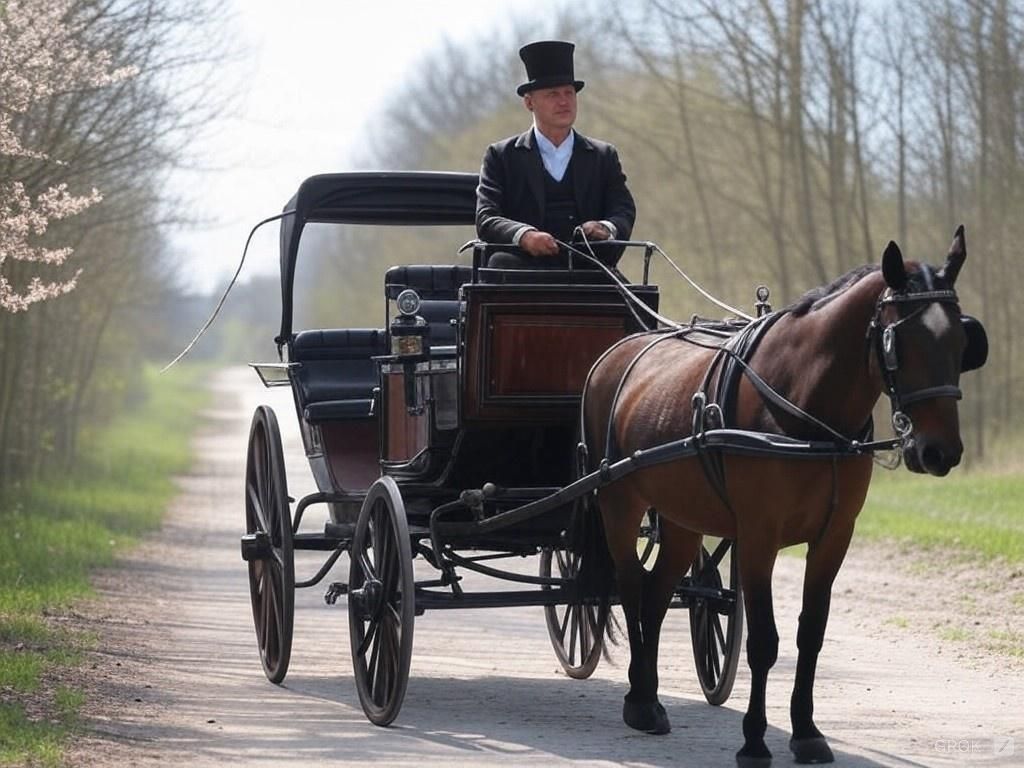
The Coachman has a human machine interface to the horse for propulsion and steering and a mechanical interface to the wheels of the coach for breaking.
The human machine interface between the coachmen and the horse consists of a two channel communication interface.
- Audio: The coachman uses his voice to transmit commands to the horse(s)
- Haptic: The coachman uses reids to have a redundant channel to his voice.
The Challenges of Communication
We learned now that coaches are steered by communication interfaces. It’s a redundant bw-wire and wireless approach. But why is this complex approach chosen? Why not just use a single lane communication channel?
Because it’s about convenience and reliability. Using the voice to control the coach is very convenient. The horse(s) can be reached with different commands and the Coachman can control everything without moving.
The reids are much more limited in the amount of commands, but are much more reliable.
Imagine driving with the coach through a crowded area. You cannot be sure anymore that the horse(s) still hear you and the audio commands might get lost. That’s what we call an Denial-of-Service Attack (DoS) or Distributed Denial-of-Service Attack (DDoS).
Coaches as well as Autonomous Vehicles must be robust against that kind of attack.
Therefore coaches have a redundant communication interface with different technologies.
For Autonomous Vehicles, we are still searching for the right setup of redundancy. But the example with the coach shows that redundancy is needed in any case.
 The Automotive Ethernet Blog